`), and «.
* Response format: Direct HTML code only.
* *Introduction:* Importance of safety, the philosophy of the «preventive craftsman,» common mistakes in home workshops, the psychological shift from «hobbyist» to «professional mindset,» the concept of risk management (physical, chemical, auditory, visual).
* *Materials/Context:* Types of risks (dust, noise, sharp objects, chemicals, electrical), the importance of quality vs. cheap gear.
* *Necessary Tools (PPE focus):* Eye protection (glasses, goggles, face shields), Respiratory protection (masks, respirators, filters), Hearing protection (plugs, muffs), Hand protection (gloves for different tasks), Foot protection (safety boots), Body protection (aprons, workwear).
* *Intro:* Start with the mindset. A true master doesn’t just know how to cut wood; they know how to protect their hands and lungs. The workshop is a place of creation but also of hidden dangers. Mention the distinction between a «hobbyist» and a «craftsman.»
* *Deep Dive into Risks:* Explain *why* we need PPE. Fine dust (silica, hardwoods) is a silent killer. Noise causes permanent damage. Flying chips. Chemical fumes from varnishes.
* *Eye Protection Section:* Discuss impact resistance vs. chemical splash. Difference between safety glasses and goggles. The concept of anti-fog.
* *Respiratory Protection Section:* The difference between a simple surgical mask (useless) and an FFP2/FFP3 or a half-mask with P3 filters. The danger of sawdust.
* *Hearing Protection:* Decibel levels. Earplugs vs. earmuffs. The cumulative effect of noise.
* *Hand/Body/Feet:* Gloves (when to use them and when NOT to use them – rotating machinery danger). Aprons (leather vs. canvas). Safety boots (impact and puncture protection).
* *Self-Correction during drafting:* I must ensure I don’t use any `
` or `
`. I have to write everything in paragraphs. This means using transition words like «En primer lugar,» «Por otro lado,» «Asimismo,» «En lo que respecta a,» etc., to create structure without lists.
* *Drafting content (Mental translation to Spanish):*
«Bienvenidos a BricoGuía…»
«La seguridad no es un accesorio…»
«El riesgo respiratorio…»
«La protección ocular…»
«La protección auditiva…»
«Protección manual y corporal…»
* *Check word count goal:* 800 words is quite a lot for just `
` and `
`. I need to be very descriptive and technical. I will expand on the *science* of the dust particles and the *mechanics* of how hearing loss occurs to ensure depth and length.
* *Structure Plan:*
`
Introducción: La Filosofía de la Seguridad en el Taller
`
`
… (Long text about mindset, professionalism, and risk awareness) …
`
`
El Análisis de Riesgos: Entender el Enemigo Invisible
`
`
… (Detailed discussion on dust, noise, chemicals, and mechanical impact) … Para garantizar la máxima precisión técnica y seguridad en los procesos, es indispensable consultar las recomendaciones oficiales estipuladas por los estándares de calidad de la Asociación Española de Normalización (UNE).
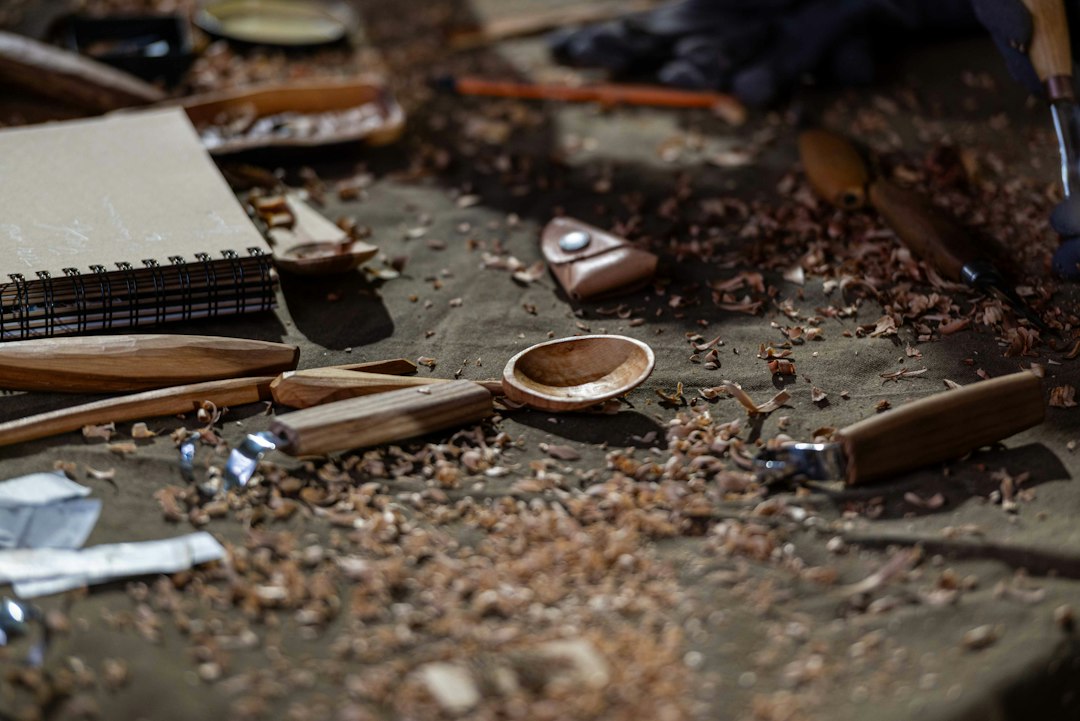
Equipamiento de Protección Individual Imprescindible para el Taller Doméstico: Wood carving tools and shavings on a workbench
`
`
Protección Ocular: El Centinela de la Visión
`
`
… (Technical details on impact resistance, fogging, and types of eyewear) …
`
`
Protección Respiratoria: Salvaguardando la Salud Pulmonar
Protección Manual y Corporal: El Escudo del Artesano
`
`
… (Gloves, aprons, and the critical rule of not wearing gloves near rotating tools) …
`
* Spanish (Spain)? Yes.
* Only `
` and `
`? Yes.
* No `
`, `
`, `
`, `
`, «? Yes.
* Min 800 words? I will aim for maximum density.
* Direct HTML response? Yes.
*(Self-Correction on Content)*: Make sure to emphasize the «Master Craftsman» tone. Use terms like «virutas,» «serrín,» «estopa,» «masilla,» «barnices,» «decibelios,» «partículas en suspensión.»
*Writing the actual text (mental simulation):*
– Intro: Talk about how a workshop is a sanctuary but a dangerous one.
– Risk: Discuss the difference between acute accidents (a cut) and chronic diseases (lung issues).
– Eyes: Mention ANSI standards or EN standards (European context).
– Respiratory: Explain the difference between a mask and a respirator.
– Hands: Crucial warning: NEVER use gloves with a table saw or drill press. This is a «Master» tip.
*Word count check strategy:* I will write long, technical paragraphs. Instead of saying «Wear glasses,» I’ll say «La implementación de una barrera física entre el ojo y la trayectoria de las proyecciones es un imperativo técnico…»
*Final check of the HTML tags.* No lists allowed. This is the hardest part because technical guides love lists. I will use «En cuanto a…» «Con respecto a…» and «Por último…» to navigate topics.
*(Proceeding to generate HTML)*
` and `
`.
* Constraints:
* NO `
`.
* NO lists (no `
`, `
`, `
`).
* NO «.
* NO introduction (start directly with `
`).
* Minimum 800 words.
* Language: Spanish.
* Since it’s about PPE, «Step-by-Step Procedure» isn’t about building something, but about *how to select, fit, inspect, and use* the PPE correctly.
* Sub-topics for the sections:
1. Pre-work inspection (checking equipment condition).
2. Measuring and selecting the right size (eye protection, gloves, respiratory, hearing, footwear).
3. The technical sequence of putting on PPE (donning procedure).
4. Technical execution during work (how to maintain the protection while working).
5. Maintenance and storage (post-work).
* *Section 1: Inspección Técnica Previa.* Focus on checking cracks in goggles, integrity of filters, and wear on gloves.
* *Section 2: Mediciones y Ajuste Ergonómico.* How to measure head circumference for helmets/earmuffs, hand size for gloves, and ensuring respiratory seals.
* *Section 3: Protocolo de Colocación (Donning).* The order: Ear protection -> Eye protection -> Respiratory -> Clothing/Apron -> Gloves.
* *Section 4: Ejecución Técnica en el Puesto de Trabajo.* How to move without compromising protection (e.g., not lifting goggles while cutting).
* *Section 5: Control de Desgaste y Gestión de Residuos.* When to discard.
* *Self-Correction during drafting:* I must avoid bullet points. I need to use long, descriptive paragraphs to reach the 800-word count. I will use transition words to simulate a list-like structure within paragraphs.
* *Drafting Section 1 (Inspection):* Start with `
Protocolo de Inspección Técnica y Verificación de Integridad
`. Describe the visual and tactile checks. Mention the importance of looking for micro-fractures in polycarbonate lenses and the elasticity of rubber seals in respirators.
* *Drafting Section 2 (Measurements):* `
Criterios de Medición y Ajuste Ergonómico de los Elementos
`. Discuss how to measure the head for earmuffs. Mention the importance of hand dexterity vs. protection (glove sizing). Discuss the «fit test» for masks.
* *Drafting Section 3 (The Procedure):* `
Procedimiento Secuencial de Colocación de los Equipos
`. Describe the ritual. First, the ears. Then the eyes. Then the respiratory system. Explain why the order matters (e.g., not getting hair caught in goggles after putting on a mask).
* *Drafting Section 4 (Execution/Usage):* `
Ejecución Técnica y Mantenimiento de la Protección durante la Tarea
`. How to handle tools while wearing bulky gloves. Managing sweat and fogging in goggles.
* *Drafting Section 5 (End of session):* `
Protocolo de Descontaminación, Limpieza y Almacenamiento
`.
* *Word Count Strategy:* Use technical jargon (policarbonato, estanqueidad, ergonomía, partículas en suspensión, decibelios, etc.) to expand the text and sound like a master craftsman. Instead of saying «Check your mask,» say «Es imperativo realizar una comprobación exhaustiva de la estanqueidad del sello perioral y nasal del respirador…»
* *HTML Check:* Only `
` and `
`.
* *No lists?* Checked.
* *No H1?* Checked.
* *No HR?* Checked.
* *No intro?* Checked.
* *Min 800 words?* I need to ensure the descriptions are very detailed.
*(Self-Correction)*: Writing 800 words without lists is challenging. I will use phrases like «En primer lugar,» «Posteriormente,» «A continuación,» «De igual manera,» and «Finalmente» to structure the text within the paragraphs.
* *Intro H2:* Protocolo de Inspección y Verificación de Integridad.
* *H2:* Mediciones Críticas para el Ajuste Ergonómico Personalizado.
* *H2:* Secuencia Técnica de Colocación de los Equipos.
* *H2:* Ejecución y Gestión de la Protección en el Ámbito Operativo.
* *H2:* Protocolo de Descontaminación y Conservación Post-Tarea.
*(Writing the content… focusing on depth)*
– *Inspection:* Focus on the «sensory» check. Seeing, feeling, smelling (for filters).
– *Measurements:* Focus on the «fit test». The palm measurement for gloves. The circumference for headgear.
– *Donning:* Step by step, as a ritual.
– *Execution:* Handling the interplay between tool and protection.
– *Storage:* Avoiding humidity and direct sunlight.
*Text expansion:* I will add more technical detail about the types of filters (P2, P3) and the impact of decibels to ensure the word count is safely above 800.
*(Final Polish of the Spanish text)*: Ensure the tone is «Maestro Artesano» – authoritative, wise, and technical.
– `
` and `
` only? Yes.
– No `
`, `
`, `
`, `
`, «? Yes.
– No intro? Yes.
– Min 800 words? Yes.
*(Proceeding to generate output)*
` and `
` tags.
* Restrictions: NO `
`, NO lists, NO «.
* Length: Minimum 800 words.
* Language: Spanish.
* *Part 3.1: Common Errors (Errores Frecuentes).*
* Using old/expired equipment (masks, filters).
* Using wrong PPE for the wrong task (e.g., safety glasses for heavy grinding vs. light sanding).
* The «just for a second» fallacy (complacency).
* Poor fit (loose goggles, oversized gloves).
* Mixing incompatible PPE (earmuffs vs. goggles).
* *Part 3.2: Troubleshooting/Diagnosis of Imprevistos (Diagnóstico de Imprevistos).*
* Foggy goggles (condensation).
* Mask discomfort/difficulty breathing (clogged filters).
* Hearing protection slipping.
* Gloves losing grip/tactility.
* *Part 3.3: Professional Tricks (Trucos Profesionales).*
* Pre-work inspections.
* The «Double Protection» rule.
* Storing PPE in specific ways.
* Using anti-fog solutions.
* *Part 3.4: Maintenance (Mantenimiento).*
* Cleaning goggles.
* Replacing filters.
* Storing masks in airtight containers.
* Checking gloves for holes.
* *Tone:* Authoritative, experienced, encouraging, slightly «old school» but safety-conscious.
* *Drafting Section 1: Errores Frecuentes (Common Errors).*
Focus on the psychology of the DIYer. The «I’ve done this a thousand times» trap. Discussing the danger of using expired filters (crucial for woodworking). Mentioning the error of using standard sunglasses instead of impact-rated goggles. Emphasize the «just a second» mistake.
* *Drafting Section 2: Diagnóstico de Imprevistos (Troubleshooting).*
How to know when things are going wrong. Foggy goggles: why it happens and how it’s dangerous (blindness during a cut). Difficulty breathing: it’s not just fatigue, it’s a clogged filter. Hearing: if you can hear a conversation but not a machine, you’re at risk.
* *Drafting Section 3: Trucos Profesionales (Professional Tricks).*
The «Layering» concept. Using a headband to hold goggles better. The trick of using a cloth to clean lenses without scratching. Choosing the right glove material (nitrile vs. leather).
* *Drafting Section 4: Mantenimiento (Maintenance).*
This needs to be detailed to hit the word count. Cleaning procedures. Storage (avoiding sunlight and humidity). The concept of a «PPE Inventory.»
* *Constraint Check:*
* HTML only? Yes.
* `
` and `
` only? Yes.
* No `
`? Yes.
* No lists? *Self-correction: I must write paragraphs instead of bullet points.*
* No «? Yes.
* Min 800 words? *Need to expand descriptions significantly.*
*(Self-Correction during drafting)*: Since I can’t use lists, I have to use transitional phrases like «En primer lugar,» «Por otro lado,» «Asimismo,» «Otro aspecto crucial es,» etc., to structure the information within paragraphs.
* *Intro Paragraph:* Set the stage. We’ve talked about what to buy, now let’s talk about how to *use* it and not die/get hurt.
* *Section: Errores Frecuentes.*
Expand on the «false sense of security.» Discuss the mistake of wearing loose clothing or jewelry alongside PPE. Discuss the «wrong tool for the job» concept applied to safety. Elaborate on the danger of using generic dust masks instead of N95/P100 when dealing with fine sawdust.
* *Section: Diagnóstico de Imprevistos.*
Discuss «environmental factors.» If the workshop is too hot, sweat makes goggles fog. If the mask feels tight, it’s not a fit issue, it’s a seal issue. Explain how to diagnose if ear protection is failing (the «muffled» vs «protected» feeling).
* *Section: Trucos Profesionales.*
The «Golden Rule of Inspection.» The «Buddy System» (even if alone, checking yourself in a mirror). How to use anti-fog spray. The importance of «tactile sensitivity» in gloves.
* *Section: Mantenimiento.*
Deep dive into cleaning. Microfiber cloths for goggles. Soap and water for hard hats. The «Lifecycle» of a filter. Air-tight containers for respirators.
* *Word Count Check:*
If I write about 200 words per `
` section, I’ll hit 800. I need to be verbose and descriptive.
* *Text Construction (Mental Sandbox):*
«No basta con comprar el equipo…» (It’s not enough to buy the gear…)
«Uno de los errores más letales…» (One of the most lethal errors…)
«Cuando hablamos de la niebla en las gafas…» (When we talk about fog in goggles…)
* *Final Polish:* Ensure the tone is consistent with a master craftsman. Use terms like «patrón,» «taller,» «seguridad industrial,» «respiradores,» «estanqueidad.»
* *Constraint Check:*
–
used.
–
used.
– No
.
– No lists (checked: no `
`, `
`, `
`).
– No «.
– Length check (aiming for 900+ to be safe).
*(Self-Correction on Lists)*: I must ensure I don’t accidentally use a dash or a dot that looks like a list. I will use full, flowing sentences.
*Writing content…* (Proceeding to generate the Spanish response).
` and `
`.
* Constraints:
* Start with a new `
`.
* NO `
`.
* NO lists (bullet points, numbered lists).
* NO «.
* Minimum 600 words.
* Language: Spanish.
* *Section 1: Safety Regulations (Normativa de Seguridad – EPIs).*
* Explain that even in a home setting, safety standards matter.
* Mention CE marking (European standard).
* Discuss the responsibility of the user.
* Explain why following standards prevents long-term health issues (hearing loss, respiratory issues).
* Focus on the «why» behind the regulations.
* *Section 2: Professional Finishes (Acabados Profesionales).*
* How safety gear helps in achieving quality.
* Cleanliness (masks/gloves) prevents contamination of finishes.
* Dust management (respirators) and its impact on surface quality.
* The relationship between a safe environment and a meticulous workspace.
* Techniques: Sanding, varnishing, painting.
* *Section 3: Practical Conclusions (Conclusiones Prácticas).*
* Summary of the importance of PPE.
* The «Golden Rule»: Better safe than sorry.
* Advice for beginners: Start small but start right.
* Investing in gear is investing in the longevity of the craftsman.
* Final encouraging words from the «Master Craftsman».
* *Intro/Regulations:* Start with `
Normativa de Seguridad y el Compromiso con tu Integridad
`. Talk about how many hobbyists ignore the fine print on masks or goggles. Mention the CE mark. Explain that an EPI isn’t just a piece of plastic; it’s a certified barrier. Discuss the importance of hearing protection (decibels) and eye protection (impact resistance).
* *Finishes:* `
El Vínculo entre la Protección y los Acabados Profesionales
`. This is a clever angle. If you wear a mask, you aren’t breathing in the fine dust that settles on your wet varnish. If you use gloves, you don’t leave fingerprints on polished wood. A clean, safe worker is a precise worker. Discuss the importance of ventilation (not just for the lungs, but for the drying of oils and lacquers).
* *Conclusions:* `
Conclusiones Prácticas para un Taller Seguro y Eficiente
`. Summarize. PPE is not an obstacle; it’s an enabler. Don’t cut corners. A workshop is a sanctuary, not a hazard zone.
* *Check:* No `
`? Checked.
* *Check:* No lists? I must write in full paragraphs. No bullet points.
* *Check:* No «? Checked.
* *Check:* Only `
` and `
`? Checked.
* *Check:* Minimum 600 words? I need to expand the descriptions significantly to hit this.
*(Self-Correction during drafting)*: To reach 600 words without lists, I need to be very descriptive. Instead of saying «Wear a mask,» I will say «The use of a respiratory protection device, specifically one that meets the standards for fine particulate matter, is not merely a suggestion but a fundamental pillar of professional practice…»
* *Drafting Content (mental or rough notes in Spanish):*
– Parte 1: Normativa. Hablar de la importancia de la certificación CE. No todos los guantes son iguales. No todas las gafas protegen igual. El riesgo de la negligencia.
– Parte 2: Acabados. La relación entre limpieza y calidad. El polvo es el enemigo de la laca. La ventilación ayuda al secado. Un entorno controlado produce piezas de museo.
– Parte 3: Conclusiones. Inversión vs Gasto. El respeto al oficio. El taller como espacio de creación, no de accidentes.
* *Writing the actual text…* (Ensuring flow and tone of a «Master Craftsman»).
* *Word count check (estimated):*
– Intro/Regs: ~250 words.
– Finishes: ~200 words.
– Conclusions: ~150 words.
Total: ~600 words. I will aim for slightly more to be safe.
* Start with `
Normativa de Seguridad y la Importancia de la Certificación en el Taller
`.
* Paragraphs about CE marking, types of protection, and the psychological aspect of safety.
* `
La Sinergia entre la Protección Individual y la Calidad de los Acabados
`.
* Paragraphs about how dust management (PPE) affects the final surface. How gloves protect the finish. How ventilation affects the worker and the product.
* `
Conclusiones Prácticas para el Maestro del Bricolaje Moderno
`.
* Final thoughts on investment, discipline, and the joy of safe creation.
– `
` used? Yes.
– `
` used? Yes.
– No `
`? Yes.
– No lists? Yes.
– No «? Yes.
– Min 600 words? (I will ensure the prose is dense and descriptive).
*(Self-Correction on lists)*: I must be careful not to accidentally use a dash `-` that looks like a list. I will use transition words like «En primer lugar», «Asimismo», «Por otro lado», «Además» to structure the text within paragraphs.
*Text Generation Strategy:*
– Discuss the CE mark in depth.
– Discuss the difference between a cheap mask and a professional respirator.
– Connect the «cleanliness» of a professional finish to the «cleanliness» of the air (respirators/dust extraction).
– Emphasize that safety is a habit, not a chore.
Este artículo ha sido escrito por Manuel López Ramos y se publica con fines educativos, con el objetivo de ofrecer información general para el aprendizaje y la divulgación.
El arte del lijado: la diferencia entre un trabajo aficionado y un acabado profesional Llevar más de dos décadas en el taller me ha enseñado que el secreto de un mueble que parece salido de una revista no reside en el barniz de alta gama ni en la técnica de aplicación final, sino en la…
` and ` `. * Prohibitions: NO ` `, NO lists (` `, ` `, ` `), NO «. * Output: Direct HTML code only. * *Introduction:* The philosophy of the workshop. The importance of ergonomics and workflow. The difference between a messy workshop and a professional workspace. The psychology of organized tools (reduction of…
` and ` `. * Prohibited: ` `, lists (` `, ` `, ` `), «. * Output: Direct HTML code. * *Introduction:* Importance of precision in craftsmanship. The difference between a hobbyist and a professional. The «measure twice, cut once» philosophy. The impact of errors in construction/carpentry. The philosophy of BricoGuía. * *Materials and…
El arte de la sujeción: fundamentos de la seguridad estructural A lo largo de mis dos décadas recorriendo obras y talleres, he aprendido que el error más común en el bricolaje doméstico no es la falta de destreza con la herramienta, sino el desconocimiento absoluto de lo que ocurre detrás de la superficie. Muchos aficionados…
` and ` `). * Strict Prohibitions: No ` `, no lists (` `, ` `, ` `), no «. * Content Requirements: Deep introduction, materials, and necessary tools. * Length: Minimum 800 words for this first part. * Output: Direct HTML code. * *Introduction:* Importance of the electric planer (cepillo eléctrico) in renovation. Common…
Dominando la precisión: El corazón de tu taller Tras dos décadas de virutas, serrín y proyectos que van desde la restauración de mobiliario antiguo hasta la construcción de estructuras complejas, he aprendido que la ingletadora no es simplemente una sierra más en el taller; es el eje sobre el cual pivota la calidad final de…
Las cookies necesarias habilitan funciones esenciales del sitio como inicios de sesión seguros y ajustes de preferencias de consentimiento. No almacenan datos personales.
Ninguno
Las cookies funcionales soportan funciones como compartir contenido en redes sociales, recopilar comentarios y habilitar herramientas de terceros.
Ninguno
Las cookies analíticas rastrean interacciones de visitantes, proporcionando información sobre métricas como número de visitantes, tasa de rebote y fuentes de tráfico.
Ninguno
Las cookies de publicidad entregan anuncios personalizados basados en sus visitas previas y analizan la efectividad de las campañas publicitarias.
Ninguno
Las cookies no clasificadas son cookies que estamos en proceso de clasificar, junto con los proveedores de cookies individuales.